


Absorbable sutures are a critical component in modern surgical procedures, offering numerous advantages over traditional non - absorbable sutures. As a leading supplier of absorbable sutures, understanding how these sutures interact with blood is essential not only for providing high - quality products but also for assisting medical professionals in making informed decisions.
1. Initial Contact with Blood
When an absorbable suture is placed within the body and comes into contact with blood, the first interaction is a physical one. Blood is a complex fluid composed of plasma, red blood cells, white blood cells, and platelets. The suture acts as a foreign body in this environment. Platelets, which are crucial for blood clotting, start to adhere to the surface of the suture.
The surface properties of the suture play a significant role in this initial interaction. For example, a suture with a rough surface may provide more sites for platelet adhesion compared to a smooth - surfaced suture. Polyglactin sutures, such as those available at Polyglactin Suture, have a specific surface structure that can influence the rate and extent of platelet attachment. Once platelets adhere to the suture, they undergo activation. Activation causes the platelets to change shape, release various chemical mediators such as adenosine diphosphate (ADP), serotonin, and thromboxane A2. These mediators further attract more platelets to the area, leading to the formation of a platelet plug.
2. Coagulation Cascade Activation
The presence of the suture also initiates the coagulation cascade. The coagulation cascade is a series of enzymatic reactions that ultimately lead to the formation of a fibrin clot. There are two main pathways in the coagulation cascade: the intrinsic pathway and the extrinsic pathway.
The intrinsic pathway can be activated by the negatively charged surface of the suture. When blood comes into contact with the suture, factor XII (Hageman factor) binds to the suture surface and is activated. This sets off a chain reaction involving several other clotting factors, including factor XI, factor IX, and factor VIII. On the other hand, the extrinsic pathway is triggered by the release of tissue factor from damaged tissues at the surgical site. Tissue factor forms a complex with factor VIIa, which then activates factor X.
Once factor X is activated in either pathway, it converts prothrombin to thrombin. Thrombin then converts fibrinogen, a soluble plasma protein, into insoluble fibrin strands. These fibrin strands form a meshwork that traps red blood cells and platelets, resulting in the formation of a stable blood clot around the suture. Different types of absorbable sutures, like Dissolvable Sutures, may have different effects on the activation of the coagulation cascade. Some sutures may be more likely to activate the intrinsic pathway, while others may have a greater influence on the extrinsic pathway.
3. Inflammatory Response
The interaction between absorbable sutures and blood also triggers an inflammatory response. The body recognizes the suture as a foreign object, and immune cells are recruited to the site. Neutrophils, the first responders of the immune system, are rapidly attracted to the area. They phagocytose (engulf) any bacteria or debris present at the surgical site and also interact with the suture.
Macrophages also play a crucial role in the inflammatory response. They are larger immune cells that can engulf larger particles and secrete cytokines and growth factors. These cytokines and growth factors help to regulate the inflammatory process and promote tissue repair. The inflammatory response is a double - edged sword. On one hand, it is necessary for preventing infection and promoting wound healing. On the other hand, an excessive or prolonged inflammatory response can lead to complications such as tissue damage and scarring.
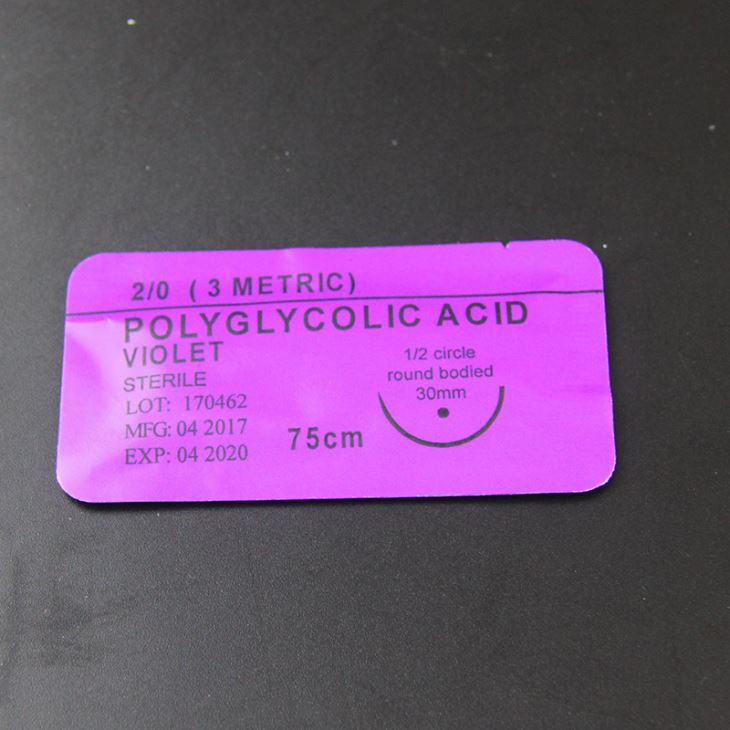
The composition of the suture can affect the intensity of the inflammatory response. For instance, Polyglycolic Acid Suture is made of a synthetic polymer. The degradation products of polyglycolic acid can influence the immune response. Some degradation products may act as chemoattractants for immune cells, while others may have immunomodulatory effects.
4. Suture Degradation and Blood Interaction
Absorbable sutures are designed to degrade over time within the body. The degradation process is mainly due to hydrolysis, which is the breakdown of the suture material by water molecules. As the suture degrades, its interaction with blood changes.
During the early stages of degradation, small fragments of the suture may be released into the bloodstream. These fragments can interact with blood components in different ways. They may be recognized as foreign particles by the immune system, leading to further immune cell activation. In some cases, these fragments may also affect the function of blood cells. For example, they may interfere with the normal function of red blood cells or platelets.
As the degradation progresses, the suture loses its mechanical strength. This can have implications for the stability of the wound. The blood clot around the suture may also start to reorganize as the suture degrades. The body gradually replaces the suture with new tissue, and the blood vessels in the area remodel to support the healing process.
5. Impact on Wound Healing and Blood Flow
The interaction between absorbable sutures and blood has a direct impact on wound healing. A well - formed blood clot around the suture provides a physical barrier against infection and helps to hold the wound edges together. The inflammatory response triggered by the suture also promotes the recruitment of cells involved in tissue repair, such as fibroblasts.
Fibroblasts are responsible for synthesizing collagen, a protein that gives strength and structure to the healing tissue. The presence of the suture can influence the orientation and distribution of collagen fibers. This, in turn, affects the quality of the scar formed after wound healing.
In addition, the suture can affect blood flow in the area. A tight suture may restrict blood flow, which can lead to ischemia (lack of blood supply) in the surrounding tissues. Ischemia can delay wound healing and increase the risk of infection. On the other hand, a suture that is too loose may not provide adequate support for the wound, leading to wound dehiscence (separation of the wound edges).
6. Clinical Significance
Understanding how absorbable sutures interact with blood is of great clinical significance. Surgeons need to choose the appropriate suture based on the type of surgery, the location of the wound, and the patient's individual characteristics. For example, in a highly vascular area, a suture that has a minimal impact on blood flow may be preferred.

In patients with coagulation disorders, the choice of suture becomes even more critical. Some absorbable sutures may be more likely to activate the coagulation cascade, which could be beneficial in patients with bleeding tendencies. However, in patients with hypercoagulable states, a suture that has a lower potential to trigger excessive clotting may be a better option.
7. Our Role as a Supplier
As a supplier of absorbable sutures, we are committed to providing products that have optimal interactions with blood. We conduct extensive research and development to ensure that our sutures have the right surface properties, composition, and degradation profiles. Our Polyglactin Suture, Dissolvable Sutures, and Polyglycolic Acid Suture are designed to minimize adverse effects on blood and promote efficient wound healing.
We also provide comprehensive information to medical professionals about the characteristics of our sutures and their interactions with blood. This helps them to make informed decisions when choosing the right suture for their patients.
8. Invitation to Contact for Procurement
If you are in the medical field and looking for high - quality absorbable sutures, we invite you to contact us for procurement. Our team of experts is ready to assist you in selecting the most suitable suture for your specific needs. We offer a wide range of absorbable sutures with different properties to meet the diverse requirements of surgical procedures. Whether you are performing a minor outpatient surgery or a complex major operation, we have the right suture for you.
References
- Stojadinovic, A., Brem, H., & Tomic - Canic, M. (2008). Wound healing and its impairment in the diabetic foot. Journal of the American Podiatric Medical Association, 98(6), 403 - 413.
- Ratner, B. D., Hoffman, A. S., Schoen, F. J., & Lemons, J. E. (Eds.). (2004). Biomaterials science: An introduction to materials in medicine. Elsevier.
- Khor, E. (1997). Polysaccharide hydrogels for modified release formulations. Critical Reviews in Therapeutic Drug Carrier Systems, 14(3), 239 - 301.


